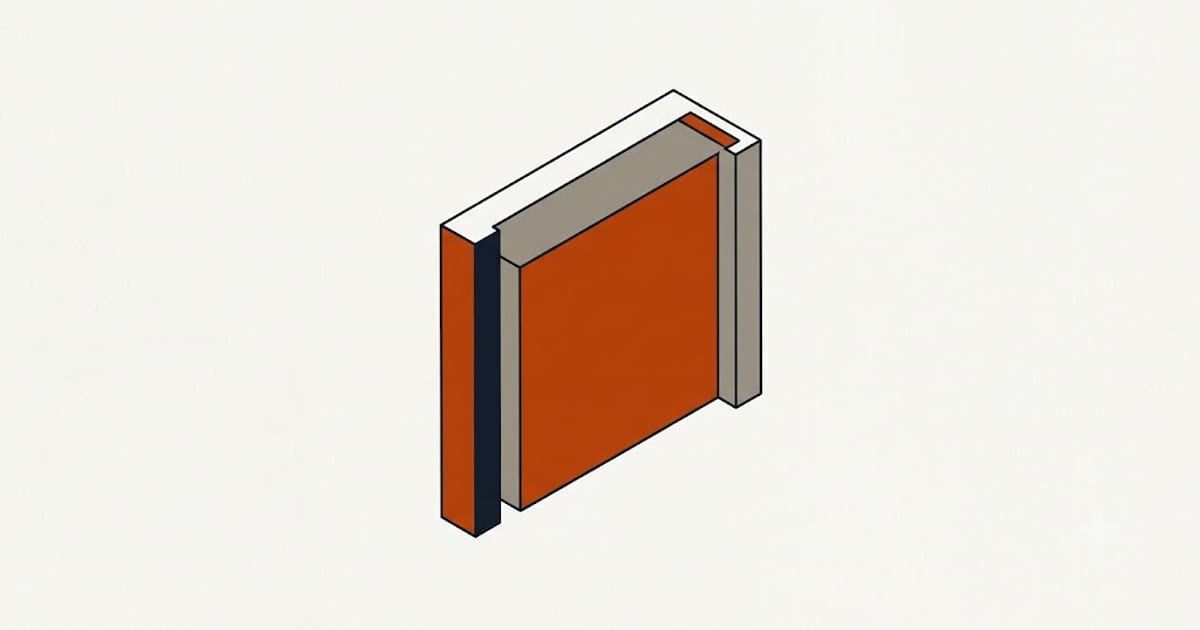
The space between the panes is filled with a gas that conducts heat less readily than air and, more importantly, convects less. Argon is the standard; krypton is the premium option.
What each one buys
Argon is about 34% less conductive than air. In whole-window terms it takes a typical double-pane down by roughly 0.02 to 0.04 in U-factor. It is inert, non-toxic, a by-product of industrial oxygen production, and cheap enough that most manufacturers include it as standard rather than pricing it separately.
Krypton is about half as conductive as argon again. It also costs many times more, and its advantage only appears in narrow gaps.
The gap width is the thing

Every gas has an optimal airspace. Too narrow and heat conducts straight across. Too wide and the gas starts circulating — warm at one pane, cold at the other — and convection carries heat that conduction would not have.
- Argon peaks at about 1/2 inch. This is why standard double-pane units are built at that spacing.
- Krypton peaks at about 1/4 to 3/8 inch, because the heavier molecule convects less readily.
That difference is the whole practical case for krypton. In a triple-pane unit the overall frame depth is fixed, so two airspaces have to share it — often around 1/4 inch each. Argon is poor at that width; krypton is at its best. In a standard double with a 1/2 inch gap, krypton buys almost nothing over argon and costs a great deal.
Fill rate, and what leaks
Units are typically filled to about 90% argon at manufacture. Getting much beyond that requires more time on the fill line than the gain justifies.
The gas then leaks, slowly, through the sealant — commonly cited at around 1% per year for a well-built unit. After twenty years a good unit still holds most of its fill; a poorly sealed one loses it much faster, and the first visible sign is usually fogging rather than a performance complaint.
Nobody measures the gas in a window in service. This means two things: the gas is not something to worry about maintaining, and it is also not something to pay a large premium for, because you cannot verify you still have it.
Where the gas ranks against everything else
Roughly, in order of contribution to whole-window U-factor on a typical double-pane unit:
- The low-E coating — by far the largest single factor
- The frame material and thermal break
- The spacer at the edge of the glass
- The gas fill — real, and smaller than the three above
- Airspace width, once it is anywhere near optimal
A window with a mediocre coating and krypton fill is a worse window than one with a good coating and plain argon, at a higher price.
What to do with this
Accept argon and do not pay extra for it — it should be standard.
Consider krypton only in a triple with narrow airspaces, and only in a cold climate where the U-factor step is worth something. In a double-pane at 1/2 inch it is money spent on the least effective part of the assembly.
Do not pay for a "gas fill guarantee." There is no field test a homeowner can perform, and the warranty that matters is the one on the seal, because a failed seal takes the gas, the coating and the clarity with it.
Why the spacer matters more than the gas
The gas sits between the panes; the spacer holds them apart at the edge and carries the seal. A traditional aluminium spacer is an excellent conductor, so it forms a thermal bridge right around the perimeter of every window — heat takes the short path through the metal and ignores the gas entirely.
Warm-edge spacers — structural foam, silicone foam, or thin stainless steel formed into a U-channel — cut that bridge. The whole-window U-factor improvement is comparable to the gas fill, and the effect on the coldest spot of the glass is larger, because the edge is where condensation forms first.
A unit with argon and an aluminium spacer has given back at the edge much of what the gas bought in the middle. If the spec sheet names the gas but not the spacer, that is the question to ask next.
What actually shows up in a cold snap
None of this is visible until an outside temperature in the teens. Then the differences between units become obvious in one specific place: the bottom two inches of glass, where the interior surface is coldest and where condensation appears first.
A window with a good coating, a warm-edge spacer and an intact fill stays clear. One with an aluminium spacer beads along the bottom rail on the same night at the same indoor humidity — same nominal U-factor on the label, visibly different behaviour on the glass, because the label averages the whole assembly and the condensation happens at the worst point rather than the average one.