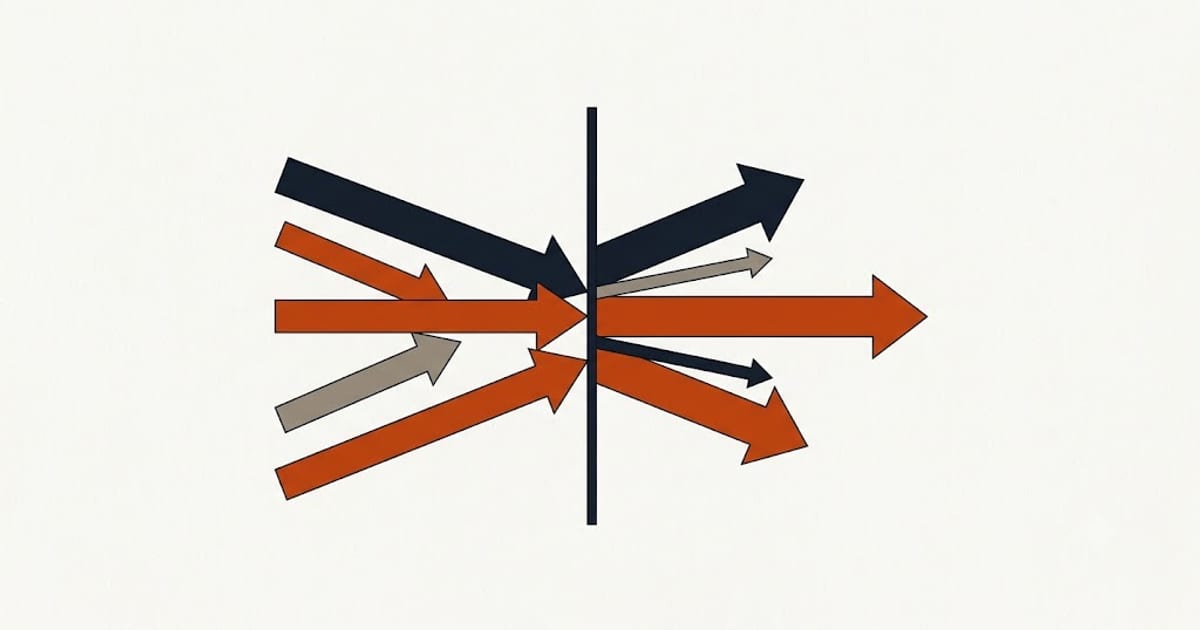
Solar heat gain coefficient is the fraction of the sun's energy striking the window that ends up as heat inside the room. SHGC 0.25 means a quarter gets through. The scale runs from about 0.80 for clear single glass down to about 0.20 for a good southern-climate coating.
Unlike U-factor, lower is not automatically better. It depends entirely on whether the house needs heat.
The rule flips at the climate line
In a cooling climate, every unit of solar gain is a unit the air conditioner has to remove. Low SHGC is the single most valuable window property in Phoenix or Orlando, and it matters far more than U-factor.
In a heating climate, solar gain through a south-facing window is free heat, arriving in daylight hours in winter when the house needs it. Blocking it is throwing away energy you have already paid for in glass.
ENERGY STAR Version 7.0 codified exactly this: the Southern and South-Central zones cap SHGC at 0.23, while the Northern zone sets a minimum of 0.17 — the first time the program required a floor rather than a ceiling.
Orientation changes the answer within one house
In the northern hemisphere, over a whole year:
- South-facing glass collects the most in winter and, because the summer sun is high, comparatively little in summer. This is the glass worth keeping SHGC high on in a cold climate.
- West-facing glass is the problem in every climate. Afternoon sun arrives low, straight through the glass, at the hottest part of the day. A west window is where low SHGC earns its money even in the north.
- East-facing has the same geometry as west but in the morning, when the house is cooler and the load is easier to absorb.
- North-facing gets almost no direct sun and its SHGC barely matters.
Ordering different glass packages by elevation is a real option that almost nobody exercises, and on a house with a lot of west glass it is worth more than a step down in U-factor.
SHGC and visible light are related but not the same
Visible transmittance (VT) is how much daylight comes through — the fourth number on the NFRC label. The ratio of the two, VT divided by SHGC, is sometimes called the light-to-solar gain ratio, and it describes how selective a coating is.
A ratio above about 1.0 means the coating passes visible light while rejecting the infrared that carries most of the heat. That is what a good modern spectrally selective low-E does, and it is why a high-performance southern window does not have to look tinted.
A cheap way to get low SHGC is simply to darken the glass, which drops VT along with it. The rooms go gloomy and the lights go on earlier, which is a real cost that no label shows.
Exterior shading beats coatings
A coating rejects heat after it has reached the glass. An overhang, an awning or a tree rejects it before. On a south elevation, a properly sized overhang blocks the high summer sun and lets the low winter sun in — which is the behaviour a fixed coating can never have, because it cannot know the season.
Where an overhang is possible, it does more than any glass upgrade and costs less.
What to ask for
Give the supplier the orientation, not just the address. "Low SHGC throughout" is right in Houston and wrong in Minneapolis, and "high SHGC throughout" is wrong in Minneapolis too — the west windows still want it low.
The right answer on most houses is two glass packages, and it usually costs nothing extra to specify.