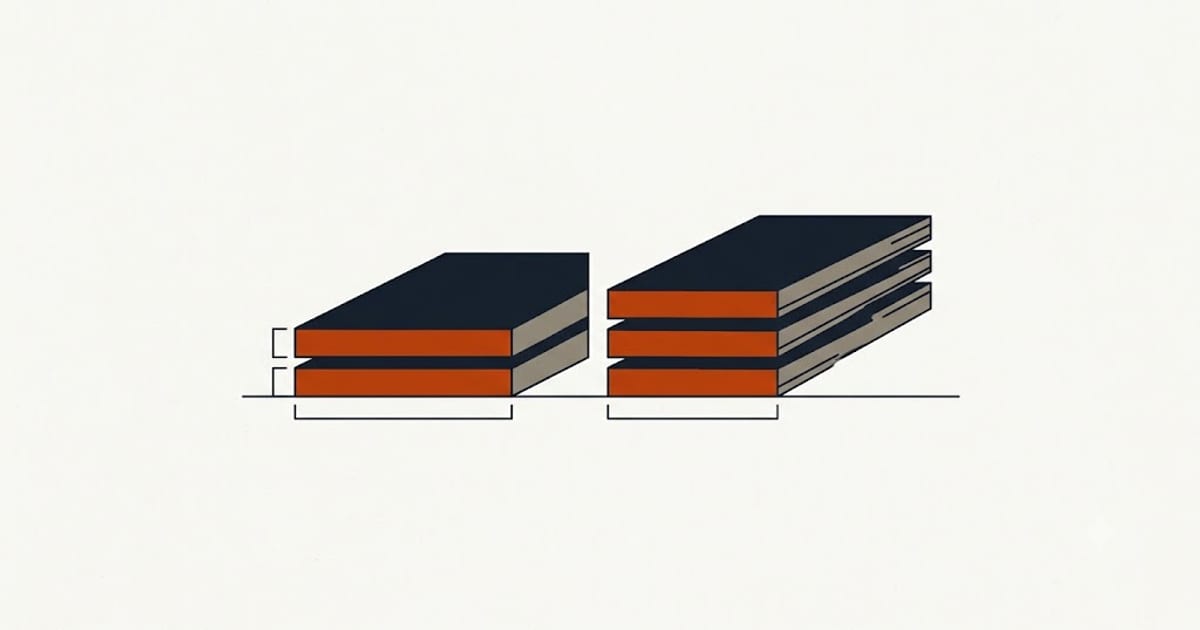
A third pane adds an extra sealed air space and a second low-E coating. In whole-window terms it typically takes a unit from about 0.28 down to about 0.20 — a real improvement, and a smaller one than the price difference suggests.
The energy arithmetic
Heat loss through a window is proportional to U-factor. Going from 0.28 to 0.20 is a 29% reduction in loss through the glazed area.
That sounds large until you scale it. Windows are typically 10 to 15% of a house's total heat loss. A 29% cut to a 12% share is about a 3.5% cut in heating energy — and triple glazing usually costs 10 to 20% more than the equivalent double.
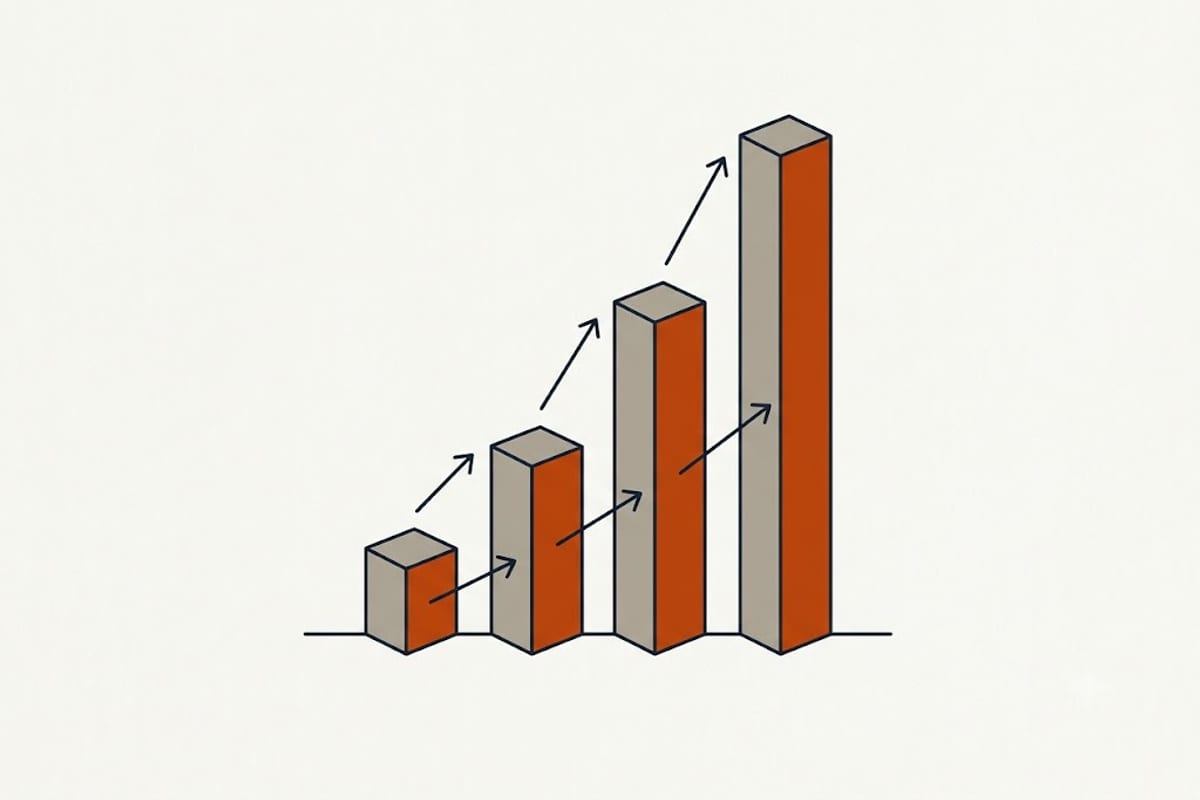
The result is that payback lands somewhere between fifteen years and never, depending on heating degree days and fuel price. In the far north with expensive electric heat it can work. In a mixed climate it does not.
The comfort case is much better, and it is separate
Two things happen at a cold window that a bill does not capture.
Radiant loss. A body near a cold surface radiates heat toward it. A 0.28 window on a 10°F night has an interior glass surface somewhere in the low 50s; a 0.20 window is several degrees warmer. The measurable air temperature is identical and the chair by the window feels different.
Convection. Air cooled by the glass falls, runs across the floor, and reads as a draught even with no leak at all. Warmer glass produces a weaker current.
Both scale with how cold it gets outside and how much glass the room has. In a room with a large north-facing window in a cold climate, this is a real change in how the space is used — and it is why people who buy triple rarely regret it even when the numbers say they should have.
Noise: it depends how you get there
Three panes are not automatically quieter. Sound transmission depends on mass and on breaking the resonance between layers, and a symmetric triple with three equal panes can perform no better than a good double.
What works is asymmetry: different pane thicknesses, wider air gaps, or a laminated pane with an acoustic interlayer. A double-pane with one laminated lite frequently outperforms a plain triple at lower cost, and it is the right specification for a house on a busy road.
If noise is the reason for the upgrade, ask for the STC and OITC ratings rather than the pane count.
What triple costs beyond the price
Weight. Roughly 50% heavier glass. Large casements can reach the limit of standard hardware, and operating them is noticeably heavier.
Frame depth. Triple units need a deeper frame, which narrows the visible glass slightly in the same rough opening.
Solar gain. A second low-E coating drops SHGC. In the Northern ENERGY STAR zone, where a minimum SHGC of 0.17 now applies, some triple packages need care to stay compliant — and on south-facing glass in a cold climate the lost winter sun partly cancels the conduction gain.
Where it clearly makes sense
- Heating-dominated climate, roughly the Northern ENERGY STAR zone
- Rooms where people sit near large glass
- A house being built or renovated to a low-energy standard, where the window is no longer the weak point
- Where the acoustic package happens to come with it
Where it clearly does not
- Cooling-dominated climates, where SHGC is the number that matters and the third pane does little
- Mild coastal climates with few heating degree days
- Any house where the walls are uninsulated or the attic is thin — the money buys more comfort somewhere else
- Rental or resale-driven work, where the payback horizon is shorter than the payback